ART / NOT ART I don't believe that Participatory activity itself is art, yet I believe that art could be one of many results which might emerge from the activity. Art is not the only, or even most desirable, result. I think that the opportunity to interact, the opportunity to communicate, is what I'm after.
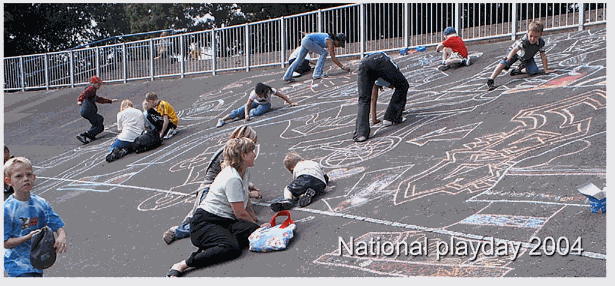
National
playday2004/Nottingham // Chalk
drawing on the tarmac of a huge running track // ART AS A DIALOGUE My chosen art-forms, drawing and painting, are traditionally individualist, even solitary practices. I like working alone for long hours. At the same time, from this realm of extreme isolation, the participatory project is one of extreme contact. It is the dynamic between these two practices that creates an interesting thought-space that allows me to develop my ideas in different ways. Art being a dialogue rather than a monologue, I would say. I feel grateful for being able to work with all sorts of communities since 2002, especially in very isolated Midlands places. I feel grateful for the chance to go freely into the lives and mindset of British people. Without it, my “take” on the experience of moving to the UK would be very different. It has been part of the process that has matured and developed my artistic vision and my practice.
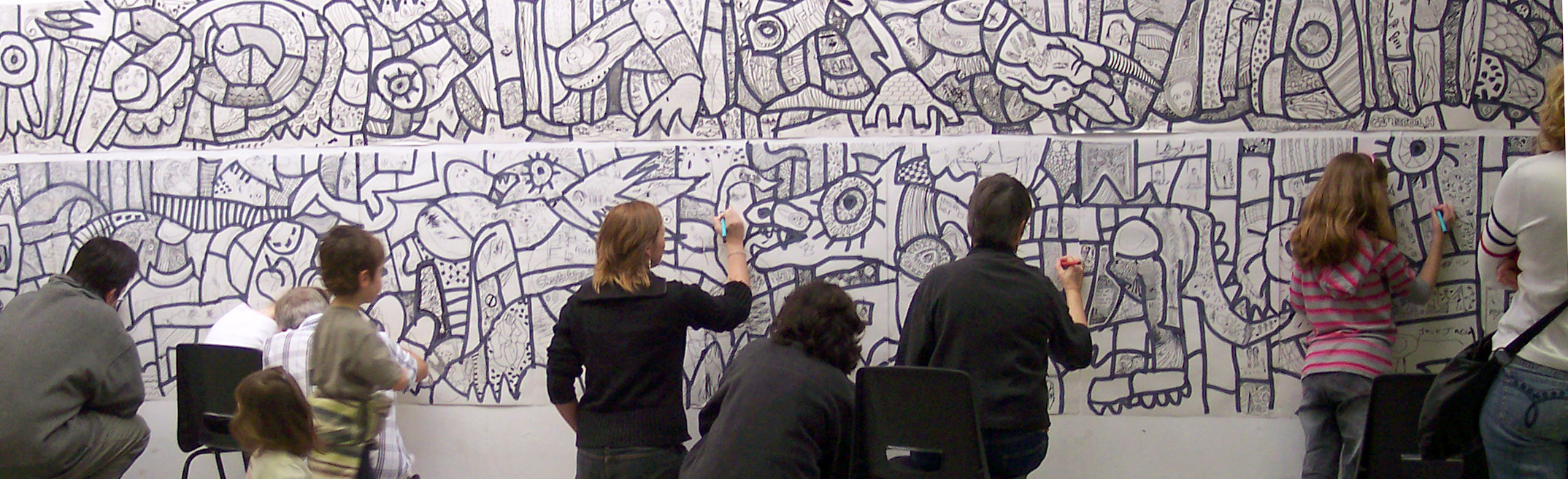
Collective work can create something the individual cannot The artist and the participants contribute, both as individual units, and as a collective mass. It is play, but play of a creative sort, the sort that Lefebvre calls “cultivated or cultural leisure” by which he means productive leisure that actively engages the participant. Participatory work allows me to talk to very diverse people in a frank and open way; I can talk to people I can't stop on the street. They tell me what they think, both to my face and within the work itself. And of course as an artist, every encounter is a chance for character exploration.
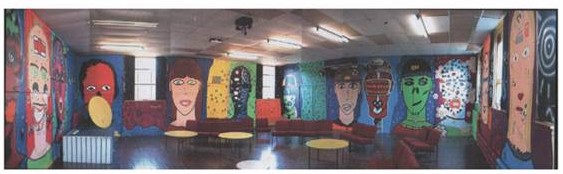
Urban History Project Participatory mural on canvas/Nottingham2005 Cultural Contribution Most leisure as it exists is substitutional, standing in for an “immediate sensory life” and is more often than not passive activity, which itself alienates or anaesthetises man from his “everyday life.” We live in a “buy not make” world. As an artist, I can create projects that are inclusive, simple, yet cumulatively spectacular, which offer something enriching, exhilarating, satisfying – much more than gadgets and consumption can offer. A relational project, where the artist creates a “space” for the public to involve themselves in the work, has within it the ability to make people feel appreciated, worthy. Art is too often experienced in a sepulchral atmosphere, and as such can be intimidating. Working side by side with the artist, sharing a joke, exchanging stores or even secrets, learning a few crafty skills, even just being in a state of not working and not shopping, is a powerful antidote to the anomie that surrounds us.
Reasserting the Artist/Audience Relationship To the “man on the street” art too often means a gimmick. Artists have a huge interest in increasing the level of public understanding towards artist, art and culture. I believe there must be a connection between the artist and the people. Art is not and should not be out of public reach and should not be much above the common perception, even while passing highly intellectual concepts. Nazir Tanbouli |